Blog Details

What’s the Minimum Car Insurance You Need in Florida? 2026 Requirements Explained


Akil Badi

Akil Badi

Insurance and Finance Writer
Auto Insurance Updated March 31, 2026 7 minute read

What’s the Minimum Car Insurance You Need in Florida? The Real Answer for 2026

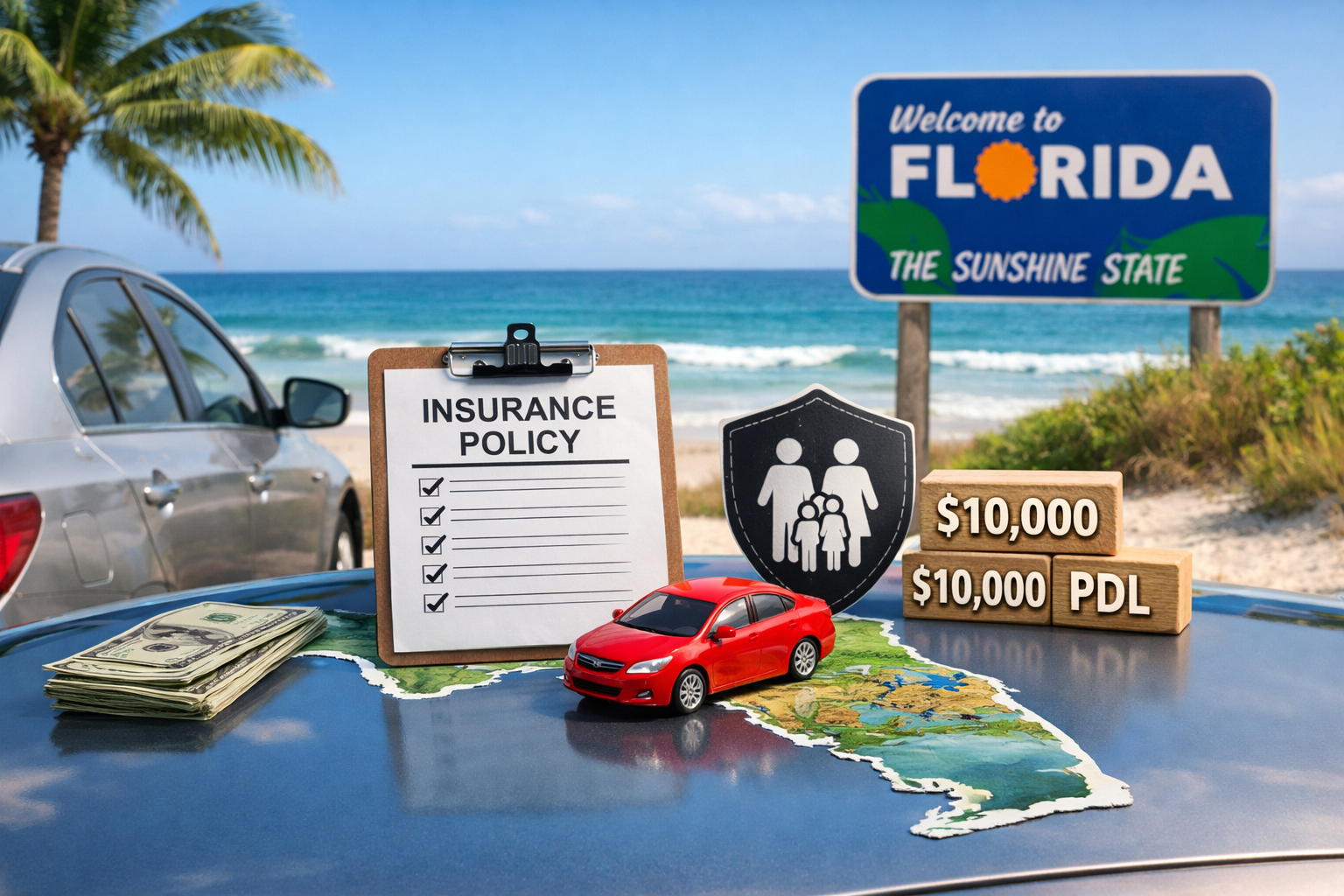
If you want the straight answer without the insurance jargon, here it is: most Florida drivers need $10,000 in PIP and $10,000 in PDL to meet the state’s current minimum requirement. The catch is that the legal minimum and the smart minimum are often two very different things.

Jump to quick answer See FAQs
$10,000 PIP Required for your own no-fault injury coverage
$10,000 PDL Required for damage you cause to other people’s property
Bodily injury liability? Usually not required for basic registration, but important in real life
Florida auto insurance hero image showing a car interior view, keys, and an insurance card at golden hour.
Quick takeaway: Florida’s current official minimum for most private passenger vehicles is $10,000 PIP + $10,000 PDL, but financed cars, DUI-related requirements, and post-crash financial responsibility rules can push the practical minimum higher.

Quick answer

If you’re searching for what’s the minimum car insurance you need in Florida, the current legal answer is simple: in most cases, you need $10,000 in Personal Injury Protection (PIP) and $10,000 in Property Damage Liability (PDL).

That is the minimum required to register and keep a four-wheel vehicle insured in Florida right now. But that bare-minimum policy leaves important gaps. It does not automatically give you bodily injury liability, it does not repair your own car after an at-fault crash, and it may not satisfy your lender if your car is financed.

2026 update you should know: You may have seen headlines about Florida repealing PIP. As of March 31, 2026, that did not happen. A 2026 repeal proposal (SB 522) died in committee, so the current official minimums remain in place.

What you’ll learn in this guide

Florida minimums at a glance What PIP really covers What PDL covers When BIL becomes required Why minimum coverage can fall short If your car is financed or leased Coverage fit finder Penalties for dropping coverage Frequently asked questions Sources and content trust

Florida minimum car insurance requirements at a glance

Here is the cleanest way to think about Florida’s current auto insurance minimums for most private passenger drivers.

Coverage Minimum amount Required for most drivers? What it generally pays for
PIP
Personal Injury Protection
$10,000 Yes Your own eligible medical expenses and part of your lost wages, regardless of fault
PDL
Property Damage Liability
$10,000 Yes Damage you cause to another person’s car or other property
BIL / BI
Bodily Injury Liability
Varies Usually no for basic registration Injuries or death to other people when you are at fault
Collision / Comprehensive Not set by Florida law No by state law Your own vehicle after a crash, theft, weather loss, vandalism, fire, and similar events
UM / UIM
Uninsured / Underinsured Motorist
Optional No Your injuries when the at-fault driver has no insurance or not enough liability insurance

Legal minimum

Enough to satisfy Florida’s basic requirement for most drivers: PIP + PDL.

Practical minimum

Often higher than the legal minimum once you factor in injury risk, vehicle value, loan terms, and how exposed your savings are.

What PIP really covers in Florida

Florida is a no-fault state, which is why PIP sits at the center of the state’s minimum insurance rules. The purpose of PIP is to get some money moving quickly for your own covered injuries after a crash, no matter who caused it.

PIP can help pay for

  • 80% of reasonable medical expenses related to the accident
  • 60% of lost wages caused by the accident
  • A $5,000 death benefit

Important limits

  • You must receive initial services and care within 14 days
  • The full medical benefit can depend on an emergency medical condition determination
  • Without an emergency medical condition, medical benefits can be limited to $2,500

In plain English: even though PIP is required, it is not unlimited and it is not a full replacement for strong liability coverage or good health insurance. It is best understood as a starting layer of protection, not the whole plan.

Common misunderstanding: A lot of drivers hear “$10,000 PIP” and assume that means all medical bills are covered up to $10,000. That is not how Florida’s rules work. PIP typically pays a percentage of covered expenses, and timing and medical documentation matter.

What PDL covers—and what it does not

Property Damage Liability pays for damage you cause to another person’s property. In a typical accident, that usually means the other driver’s vehicle. It can also apply to things like a fence, mailbox, storefront, telephone pole, gate, or building.

Usually covered by PDL

  • The other person’s car repairs
  • Damage to a fence, wall, gate, or structure
  • Damage caused by you or someone driving your insured vehicle

Not covered by PDL

  • Your own car repairs after an at-fault crash
  • Your own medical bills
  • The other person’s injuries

This is one reason the state minimum can feel thinner than people expect. A single newer vehicle can easily exceed $10,000 in damage. If you only carry the legal minimum, you could still be personally responsible for whatever goes over your PDL limit.

Does Florida require bodily injury liability?

For most drivers registering a standard four-wheel vehicle, bodily injury liability is generally not required just to meet Florida’s basic minimum rule. That is one of the most important details people miss when comparing Florida with other states.

But “not required for most drivers” does not mean “never required.” Bodily injury liability can become mandatory in certain situations.

Situations where BI can be required

  • After a DUI conviction, with much higher required limits
  • For certain drivers under Florida’s financial responsibility rules after crashes or citations
  • For taxis and some special vehicle categories

Why drivers still buy it

  • It helps protect your savings if you injure someone
  • It usually pays for your legal defense if you are sued
  • It gives you access to matching or stronger UM options with many insurers
The short version: Florida’s legal minimum may let you skip bodily injury liability in many everyday cases, but real-world financial risk does not skip you back.

Why the state minimum is often not enough

The legal minimum is designed to satisfy the law, not necessarily to protect your budget after a serious crash. That difference matters a lot in Florida.

Where minimum coverage can leave a gap

  • Your PDL may not be enough for a newer vehicle or multiple damaged items
  • Your PIP does not pay 100% of covered medical costs
  • You may have no bodily injury protection for claims made against you
  • Your own car may have zero crash coverage if you skipped collision

Smarter upgrades many drivers consider

  • Bodily injury liability
  • Uninsured / underinsured motorist coverage
  • Collision and comprehensive
  • Rental reimbursement or towing if you rely on your car daily

A helpful way to think about it is this: the state minimum is the ticket to be legal. A stronger policy is the plan to stay financially stable if something goes wrong.

If your car is financed or leased, the true minimum is usually higher

State law and lender rules are two different things. Florida may only require PIP and PDL for most drivers, but your lender or leasing company will often require comprehensive and collision for the life of the loan or lease.

Why this matters: If you let required lender coverage lapse, the lender may buy force-placed insurance to protect its interest in the vehicle. That kind of policy can cost more and may protect the lender more than it protects you.

So if you finance your car, the practical answer to “what’s the minimum car insurance you need in Florida?” is usually not just the state minimum. It is the state minimum plus whatever your loan or lease contract requires.

Coverage fit finder

Use this simple guide to see which baseline fits your situation best. This is educational only, not personalized advice.

Baseline: legal minimum only

This is the bare-minimum setup for most Florida drivers who want to meet the law and nothing more. It keeps you legal, but it can leave major out-of-pocket risk after a serious crash.

Carry: $10,000 PIP + $10,000 PDL
Best for: Drivers focused on legal compliance only
Big caution: No built-in protection for other people’s injuries and no repairs for your own car after an at-fault crash

What happens if you cancel coverage too early?

Florida expects continuous required coverage while the vehicle remains registered. That is true even if the car is not being driven or is temporarily inoperable.

  • If you cancel first and keep the plate, your registration and driving privilege can be suspended.
  • Reinstatement fees can reach up to $500.
  • The safer move is to surrender the plate before canceling if you no longer want coverage on that vehicle.

This is one of those small details that saves people from a large administrative headache later.

Frequently asked questions

These are the questions drivers usually ask right after learning Florida’s minimums.

For most drivers, the current minimum is $10,000 in PIP and $10,000 in PDL. That is the basic legal requirement for most four-wheel private passenger vehicles in Florida.
Usually not for basic registration of a standard private passenger vehicle. However, it may be required in specific situations, including certain financial responsibility cases and DUI-related requirements.
No. Florida PIP generally pays 80% of eligible medical expenses and 60% of lost wages, subject to policy rules and benefit limits. Timing matters too: initial care generally must begin within 14 days.
Usually no. Florida’s minimum requirement does not include collision coverage. PDL pays for damage you cause to other people’s property, not repairs to your own vehicle.
In many cases, yes. Lenders and leasing companies commonly require comprehensive and collision coverage for the life of the contract, which means your real-world minimum is higher than the state minimum.
No. A 2026 proposal to repeal the no-fault system did not become law. The official minimums currently remain $10,000 PIP plus $10,000 PDL.

Content trust

Last updated: March 31, 2026
Reviewed against: official Florida state sources and Florida consumer guidance

This guide is written in plain English for consumers. It is educational content, not legal, financial, or insurance advice. Coverage needs can change based on your vehicle, loan terms, driving history, and personal assets.

Primary sources

Content Trust

Last updated: March 31, 2026

Reviewed by: Akil Badi

Financial and insurance disclaimer: This content is for educational purposes only and is not financial, legal, tax, or insurance advice. Consult a licensed advisor before making coverage or investment decisions.

Community Feedback

0 Approved

Comments are moderated to reduce spam and off-topic submissions.

No approved comments yet. New submissions appear only after moderation.

Leave a Comment

Your email address will not be published. Every submission is checked before it goes live.